THE PURPOSE OF THE ORDINANCE
The ordinance sets out a clear process and rules for any potential utility scale solar proposal to follow.
Approval of the ordinance does not automatically approve any project but instead creates a process for evaluating proposals and ensuring that each project both protects and benefits the Town of Chino Valley. Town Council retains the ability to approve projects in their sole and absolute discretion.
Since Chino Valley does not collect property tax, the ordinance introduces a payment-in-lieu-of-tax system, which provides an avenue for the town to seek a direct financial benefit from these projects. A Development Agreement for any solar project coming before Council would establish the negotiated community benefit fee, expected to range between $500 and $1,000 per acre per year, with all funds going directly to road maintenance and improvements. The ordinance, as proposed, caps the total utility- scale solar acreage at 3,800 acres, meaning if all acreage is approved and fully developed (minus the current 290-acre APS site), it COULD generate between $1.75 million and $3.5 million annually for infrastructure, over the life of the project. This will be formalized through a required Development Agreement with any proposed solar project. Any and all Development Agreements are reviewed by the Town's legal counsel before any Council action to assure whatever is proposed meets the current legal standards for such agreements.
PROTECTIONS FOR THE TOWN
- Development Agreement Requirement: All protections, including community benefit fees, must be included in a Town Council-approved development agreement. If any part is unsatisfactory, the project is denied.
- Site Grading: Limit grading to 20% of the area, prohibit solar panels on slopes over 5%, and ban blasting.
- Wildlife Protection: Submit an AZGF-approved Wildlife Protection Plan, maintain corridors, install wildlife-friendly fencing, and support conservation efforts.
- Public Safety & Fire Mitigation: Annex into a fire district and provide Fire and Natural Disaster Mitigation Plans. The Fire Mitigation Plan must be approved by CAFMA. Battery Energy Storage Systems (BESS) must be at least one mile from residential areas or centrally located, complying with 2024 Building Codes.
- Water Usage Protections: Submit a Water Usage Plan to assess sources, limit consumption, and incorporate fire suppression strategies.
- Environmental Protections: Implement a Storm Water Pollution Prevention Plan (SWPPP) to manage runoff and aquifer recharge. A Property Maintenance Plan must control vegetation and limit herbicide use. Cumulative development is capped at 3,800 acres with a 3-mile minimum separation between projects.
- Traffic & Roads: Conduct a Traffic Impact Analysis and create a Road Improvement Plan for both construction and operation.
- Screening & Setbacks: Use a 7-foot masonry wall for storage areas, conduct a Viewshed Analysis, and submit a Fencing Master Plan. Maintain a 1/4-mile buffer from developed residential areas and the Peavine Trail.
- Glare & Panel Safety: Use low-reflective materials, ensure durability, and promote panel recycling.
- Noise & Light Pollution Controls: Limit construction hours (weekdays 8 AM–5 PM), conduct noise studies, and maintain post-construction noise levels below 55 dB (day) and 40 dB (night). Lighting must comply with Dark Sky regulations.
- Drones: If used, submit a Drone Utilization Plan covering flight paths, noise, and regulatory compliance.
- Decommissioning & Reclamation: Developers must submit a long-term Site Restoration Plan, financially updated every three years, ensuring financial accountability.
- Public Engagement: Developers must provide a Town-approved Public Outreach Plan and conduct public outreach before project approval, to maintain transparency.
PROCESS FOR A UTILITY SCALE SOLAR APPLICATION UNDER THE ORDINANCE:
- Step 1 – Rezoning, if required.
- Step 2 – Preliminary Solar Facility Use Permit, which is confirmation of the Siting Requirements as outlined in the ordinance.
- Step 3 – Final Solar Facility Use Permit, which includes all of the studies that confirm Project Standards, as outlined in the ordinance.
PREVIOUS ACTION
- On November 5, 2024 Staff presented this item to the Planning and Zoning Commission who continued the item to January 7th in order for Staff to address concerns brought up by the Public and the Commission.
- On January 7, Staff presented this item, with the changes requested identified in blue in the language, to the Planning and Zoning Commission who forwarded a recommendation of approval to the Town Council with a vote of 5-1.
PLANNING AND ZONING COMMISSION RECOMMENDATION TO COUNCIL
Approve Ordinance No. 2025-949 to amend the Town of Chino Valley Unified Development Ordinance, Chapter 4 General Regulations, to add Section 4.33 Utility-Scale Solar Photovoltaic Facilities.
ADDITIONAL DETAIL:
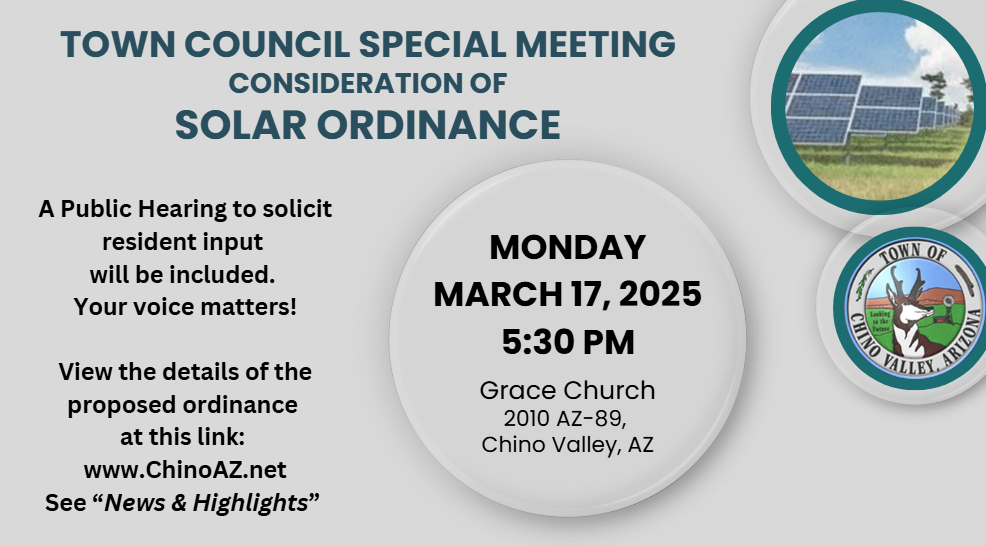
CHINO VALLEY RESIDENTS ENCOURAGED TO ATTEND. MEETING WILL INCLUDE PUBLIC COMMENT. LET YOUR VOICE BE HEARD!